
The Ultimate Home Dartboard Buying Guide: How to Choose, Install and Maintain the Right Board
The Ultimate Home Dartboard Buying Guide: How to Choose, Install and Maintain the Right Board
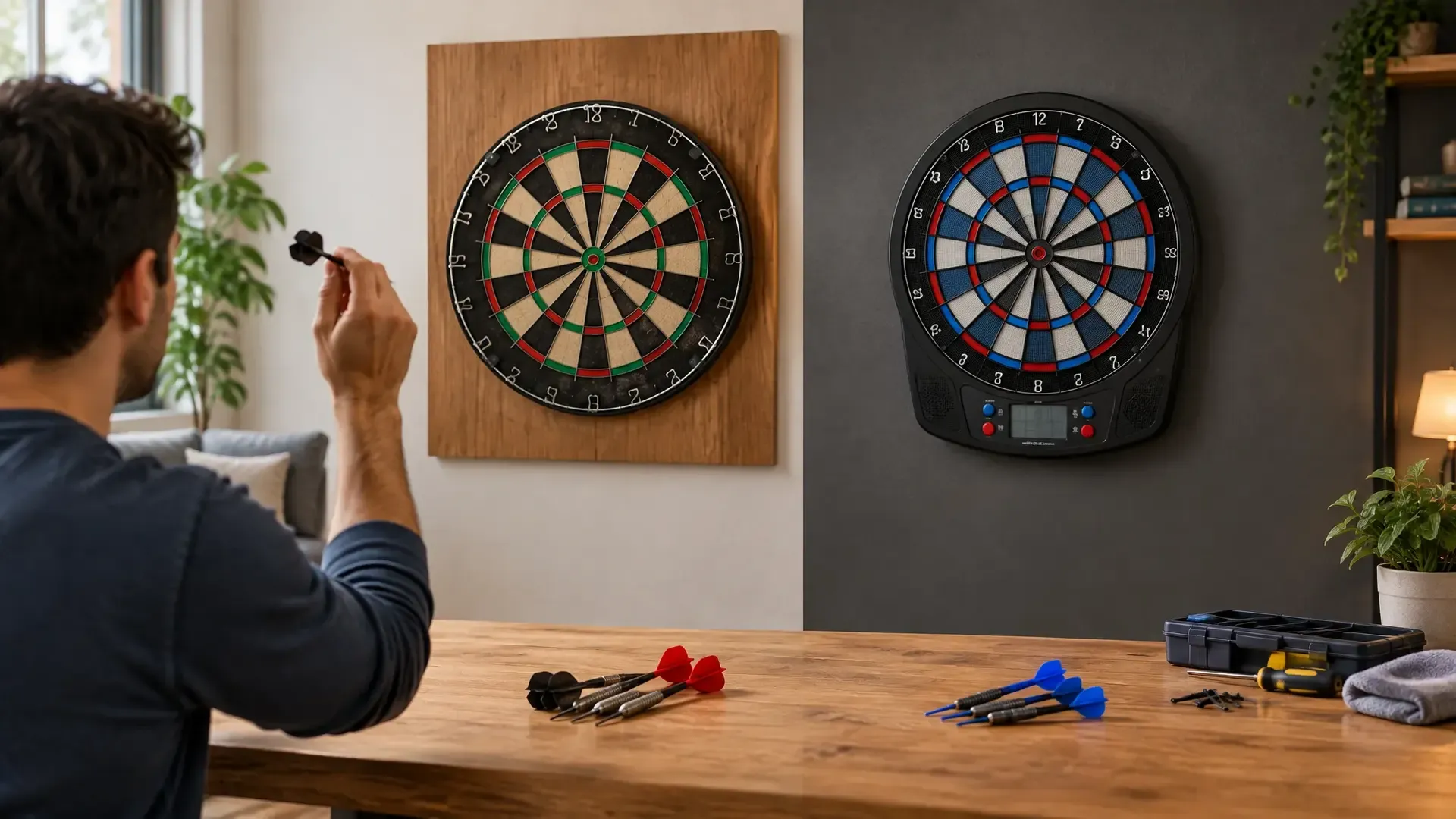
The best dartboard for home use is the one that fits your playing style, available space and tolerance for noise and maintenance. A traditional bristle or sisal board is usually the natural choice for pub-style play and serious practice, while an electronic board can make scoring easier and offer a more approachable setup for casual or family games. Neither type is automatically better for every household.
The right purchase depends on where you will play, who will use it, whether you prefer steel-tip or soft-tip darts, and how much effort you want to put into installation and upkeep. Compare those practical details before comparing brands or individual models.
Bristle or electronic: which board suits your home?
Bristle and sisal boards are the traditional option for steel-tip darts. Their playing surface is made from compressed natural fibres, and darts are designed to enter the surface and leave a relatively small mark. The feel is familiar to pub and league players, and a well-made board can be used for focused practice as well as recreational games.
These boards do require more from the player and the room. You normally need to handle scoring yourself, provide a suitable wall fixing, protect the wall and floor, and accept the sound of steel-tip darts striking the board. Noise can transfer through a wall, particularly in an apartment or a room next to a bedroom. A surround and a floor mat can reduce damage from wayward darts, although they do not make an unsafe layout safe. Read also: cricket darts.
Electronic boards are generally designed for soft-tip darts and use sensors to register scores. Automatic scoring, game options and multiplayer features can make them appealing to beginners, families and players who want a simple evening activity. They may also reduce the risk of a sharp steel point hitting the wall, but soft-tip darts can still cause damage and should never be treated as harmless.
An electronic board also brings different compromises. It needs power or batteries, may produce electronic sounds, and can require cleaning or troubleshooting according to its manual. Its scoring system may not match steel-tip rules or the feel of a traditional board. If your main goal is league-style practice, a sisal board is usually the closer match. If convenience and guided scoring matter most, electronic may be the better fit.
What to look for in board quality
On a sisal board, look for a dense, even playing surface with clearly defined segments and numbers that remain easy to read under your chosen lighting. The surface should not look excessively patchy, loose or uneven. Fibre quality matters, but it is only one part of durability: the mounting system, usage, dart points and maintenance all affect how long a board remains enjoyable.
Staple-free or reduced-staple construction can leave more usable scoring area and reduce obstructions around the segments, but it is not a guarantee of a superior board. Segment design and wiring also matter. Thin or well-positioned dividers can make more of the surface available, while bulky dividers may catch darts or create more bounce-outs. These features should be considered alongside construction quality rather than used as a single quality test.
Check what comes with the board. A secure mounting bracket, fixing hardware, numbering ring or protective backing may be included, but packages vary. Do not assume that included fixings are suitable for every wall. The wall material and its condition should determine the correct fixing method, and the manufacturer’s instructions should take priority.
For electronic boards, inspect the visibility of the display, the clarity of the segment layout, the controls and the available scoring modes. Consider where the power connection will sit and whether the cable can be kept away from the throwing area. A feature-heavy board is not necessarily the best choice if its display is hard to read or its controls make a simple game frustrating.
Size, format and playing space
Traditional boards are often chosen for a regulation-style experience, but home rooms do not always allow a complete competition layout. Before buying, measure the wall, the available floor depth and the space needed for someone to stand and throw without crossing into a walkway. Leave room around the board for retrieving darts and for other people to move safely.
Exact board dimensions, bull height and throwing distance should be checked against the rules of the organisation or format you want to follow. Governing bodies and manufacturers may specify details differently, and electronic boards can use a different layout from a steel-tip setup. When a home arrangement cannot meet the preferred standard, label it as a practice or recreational setup rather than assuming it is regulation-compliant.
Measure the mounting height from the floor to the centre of the bull, not to the top edge of the board. Measure the throwing distance from the correct face or front reference point specified for your board and format. Mark both points clearly, and follow the board instructions if the mounting system changes the board’s position from the wall.
How to install a sisal dartboard safely
Choose a solid, suitable wall and use fixings appropriate for its construction. A dartboard should not be mounted merely because a screw fits; loose hardware, weak plaster or an unsuitable bracket can allow the board to fall. Keep the setup away from glass, fragile furniture and busy doorways, and make sure everyone in the room understands when darts are being thrown.
Protect the wall with a properly fitted surround or other suitable backing, and consider a dart mat to protect the floor and help mark the throwing line. Good lighting should illuminate the scoring surface without shining directly into the player’s eyes. The throwing lane should be clear, and children and pets should be kept outside it while darts are in use.
If the board supports rotation, turn it periodically according to the manufacturer’s guidance so that frequently used areas do not receive all the wear. Do not rotate a board that is not designed for it, and do not force a bracket or numbering ring into a new position. For more help with how practice can be structured once the setup is ready, darts practice routines can be a useful next step.
Noise, safety and everyday home suitability
Noise is one of the most overlooked buying factors. Steel-tip darts striking sisal create a sharp impact, and missed darts can strike the wall or floor. A surround and mat help with protection, but soft furnishings, room position and the construction of adjoining walls also influence how noticeable the sound is. If quiet play is essential, investigate whether an electronic board’s impact and operating sounds are acceptable rather than assuming it will be silent.
Steel-tip darts need more careful supervision, especially around children and pets. Soft-tip darts are less hazardous in some situations but still have points and should be stored safely. Keep spare darts, points and accessories out of reach, and inspect the board, surround and mounting hardware regularly. Stop play if the board shifts, a fixing loosens or a segment becomes unsafe.
A lighting system should make the entire scoring area visible without casting strong shadows. Avoid improvised lights that hang into the throwing line or leave cables where someone can trip. A compact home setup can work well, but only when the board, player and people nearby have enough separation.
Maintenance and running costs
Sisal boards should be kept dry and protected from damp conditions. Remove loose dust gently in the way recommended by the manufacturer, and avoid soaking, spraying or aggressively brushing the playing surface. Rotate the board only if its design allows it. Check the points on your darts as well: damaged or excessively rough points can contribute to unnecessary surface wear.
Electronic boards should be cleaned and maintained according to their manual. Keep liquids away from the controls and display, inspect power leads and adapters, and replace batteries when required. Worn sensors, unresponsive segments or inconsistent scoring are signs that the board needs attention rather than problems to ignore. No board has a guaranteed lifespan, because use, environment and care make a substantial difference.
A sensible budget-to-premium buying framework
A budget board can be suitable for occasional family play when the priority is trying darts without committing to a demanding setup. Accept that the surface, dividers, accessories or included hardware may involve compromises, and focus on safe mounting and clear visibility.
A mid-range board is often the balanced choice for regular home use. Spend more here if several people will play, if you want a more consistent practice surface, or if the board will be used frequently. Prioritise construction, segment clarity, a dependable mounting method and the accessories needed to protect the room.
A premium board makes more sense for a committed player who values traditional feel, repeated practice and a setup closer to organised play. It can be worth paying for a better surface and considered construction, but premium pricing does not remove the need for correct installation or maintenance. If automatic scoring is your priority, put the budget toward a clear display, reliable sensors and practical power arrangements rather than novelty features alone.
Pre-purchase checklist
- Choose steel-tip sisal for traditional practice, or soft-tip electronic play for guided scoring and convenience.
- Measure the wall, floor depth, lighting position and throwing lane before ordering.
- Confirm the board format, mounting method and included accessories.
- Plan a surround, floor protection and safe storage for darts.
- Check the relevant rules if you want a regulation-style setup, and verify every measurement against the board or governing-body instructions.
Frequently asked questions
Is a bristle dartboard better for beginners?
It is better for beginners who want to learn steel-tip darts and practise in a traditional format. An electronic board may be easier for beginners who value automatic scoring and game prompts.
How high should a dartboard be mounted?
Use the required bull-centre height for the rules or format you intend to follow, measuring from the floor to the centre of the bull. Verify the exact figure in an authoritative current rules source or the manufacturer’s instructions rather than relying on a generic home diagram.
Can an electronic board replace a sisal board?
It can replace one for casual soft-tip games, but not necessarily for a player who wants steel-tip feel, traditional scoring practice or a league-style setup. The choice depends on the type of darts you intend to play.
How can I improve after choosing a board?
Once your setup is safe and consistent, practise scoring as well as throwing. A darts checkout chart can support checkout work, while a properly protected board helps you practise without turning every session into a repair project.
Conclusion
The best dartboard for home is a considered match between board type, playing goals, room constraints and maintenance habits. Choose sisal for traditional steel-tip play and serious practice; choose electronic for convenient soft-tip games and automatic scoring. Whichever route you take, prioritise a secure installation, suitable protection, clear lighting and a format that the intended players will genuinely enjoy.