
8-Week Progressive Darts Practice Plan: Improve Scoring, Triple Accuracy and Checkout Finishing
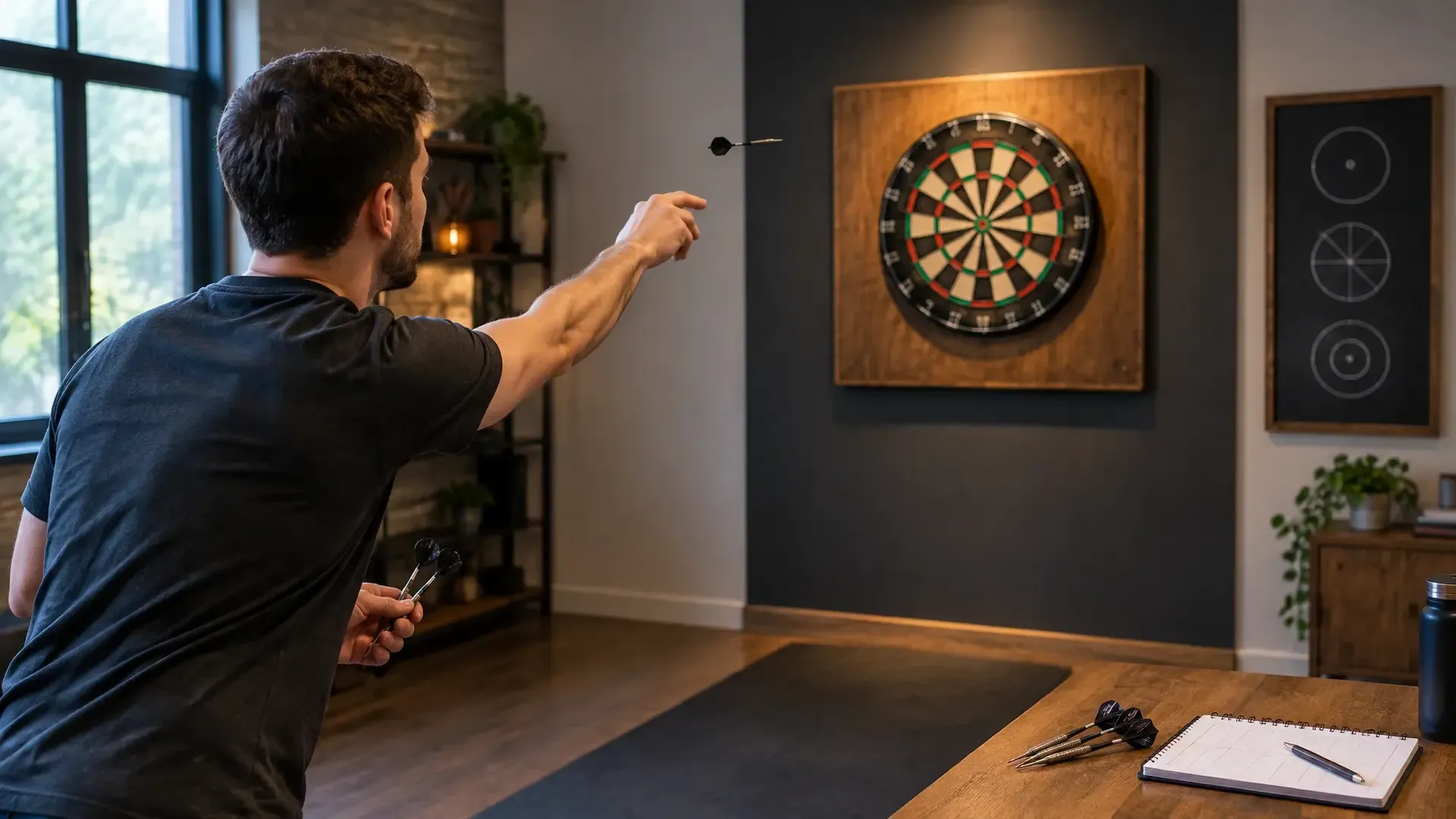
8-Week Progressive Darts Practice Plan
A good darts practice plan should make every visit to the board purposeful without turning practice into a test of endurance. This eight-week programme moves from a consistent throw and reliable grouping to triple accuracy, checkout finishing and match pressure. It suits beginners and competitive players because the volume can be adjusted while the measurements stay comparable.
Practise three to five times per week if your schedule allows. A standard session takes about 45–60 minutes, while a short session can be completed in 20–25 minutes. You need a regulation-height, securely fixed board, a clear throwing area, your usual darts and a way to record results. Use the same stance, oche position, lighting and scoring method whenever possible. If your release becomes rushed or your darts begin spreading because of fatigue, reduce the volume or stop rather than reinforcing poor technique.
Set your baseline before Week 1
Before beginning, complete one baseline session when you are reasonably fresh. Start with a scoring sample of 30 darts at the 20 segment, recording the total and dividing it by 10 to produce a three-dart average. Then throw 30 darts at a selected triple, such as treble 20, and record how many hit that triple. Your triple-hit accuracy is the number of successful hits divided by 30, multiplied by 100.
For finishing, choose five common checkout ranges and give yourself three attempts at each, using three darts per attempt. Record whether each attempt is completed. Checkout percentage means successful checkouts divided by total checkout attempts, multiplied by 100. Keep the same ranges for the Week 4 and Week 8 retests so the comparisons are meaningful.
Also note your first-nine average, which is the average score from the first nine darts of each leg or scoring visit, and rate fatigue and confidence from 1 to 5. These notes help distinguish a genuine improvement from one unusually good score.
A repeatable session structure
Use this framework throughout the programme. In a short session, throw 10 minutes of warm-up and grouping, 10 minutes of the week’s main drill, and finish with five minutes of doubles or a pressure game. A standard session uses 10 minutes of warm-up, 20 minutes of scoring or triple work, 15 minutes of doubles and checkouts, and 10 minutes of pressure play. An extended session can add one more 20-minute block, but take a short break between blocks.
Begin with relaxed throws at large single segments, then move to the week’s target. Finish each session with a brief review: write down your key metric, fatigue and confidence, and one technical observation. For more ideas that can fit around this structure, use these darts practice routines rather than adding exercises without a clear purpose.
The eight-week progression
How to practise triples and checkouts
For a useful triple drill, nominate one target and throw 10 visits of three darts. Count both total hits and visits containing at least one hit. The first measure shows accuracy; the second shows how often you give yourself a scoring opportunity. Progress by improving the hit percentage without allowing your grouping to deteriorate. You can also call a combination before each visit, such as a treble followed by two scoring singles, and count only combinations completed in the intended order.
Doubles work should include both isolated accuracy and realistic finishes. Practise a preferred route from each range, but treat it as a repeatable option rather than a universal rule: routes depend on the remaining score, your preferred double and the match rules. A darts checkout chart can help you compare options, while your log should identify the routes you actually trust.
Use a missed-dart routine every time. If the first dart misses, pause, reset your feet and choose the sensible remaining target before throwing again. Do not automatically repeat the same dart if the miss has blocked the bed or changed the available route. In the final two weeks, include pressure attempts where the checkout counts only if completed within three darts. Record these separately from relaxed doubles practice.
Track progress without chasing perfect numbers
At the end of each week, log your scoring average, first-nine average or equivalent scoring sample, triple-hit accuracy, doubles percentage, checkout percentage, session consistency and fatigue. Session consistency can be a simple count of visits that meet your chosen scoring target, or the difference between your best and worst scoring sessions. Keep the definition unchanged throughout the plan.
One variation game, such as cricket darts, can add target switching and reduce the risk of becoming accurate only on one isolated segment. Use it as supplementary practice, not as a replacement for the scoring and checkout tests. The aim is transferable match skill: choosing targets, recovering after a miss and finishing when the pressure rises.
Adaptations, rest and troubleshooting
With only 15–20 minutes, warm up briefly, complete one main drill and finish five pressure checkouts. Beginners should use fewer targets and concentrate on a repeatable throw before increasing volume. Competitive players can add visits or simulated legs, but should preserve the same weekly metrics. A rest day is useful after demanding match simulations, and at least one lighter session each week can help maintain quality.
If scoring plateaus, review grouping and first-nine results rather than reacting to one low leg. If doubles remain poor, spend the first half of a session on one or two preferred doubles and the second half on realistic checkouts. If technique deteriorates, shorten the session. Players who cannot practise every day can still make progress with three focused sessions per week; daily practice is optional, not a requirement.
What to do after Week 8
Compare the three test points and look for patterns. If triples improved but checkouts did not, retain two finishing sessions in the next cycle. If checkout percentage rose while scoring fell, keep the finishing work and restore a scoring block. If fatigue was consistently high, reduce volume before adding difficulty. Repeat the strongest parts of the plan with two clear priorities, keeping a short maintenance block for every area that already improved.
Progress is best judged across repeated sessions, not by a single high score. A consistent throwing setup, honest records and deliberate finishing practice give you a practical foundation for the next training cycle.